


Can You Babywear While Pregnant? Tips and Carrier Recommendations
A question we get asked a lot here at hope&plum is, “Can I babywear while pregnant?” The short answer is, “Yes!”
If you’re asking this question, you’ve probably been babywearing your older child through their life, and you definitely do not have to stop when expecting a new little one. Of course it’s always best to listen to your body and check with your healthcare provider, but people experiencing healthy pregnancies can babywear right up to delivery. The key is to find the best carrier and wearing style to suit your changing body.
TL;DR:
Yes, you can babywear while pregnant if you’re having a healthy pregnancy—always listen to your body and check with your healthcare provider.
Adjust your carrier waistband above or below your bump for comfort; ring slings and wraps are great no-waistband options.
Revisit your carrier fit and tighten all slack—small adjustments make a big difference as your body changes.
Front and back carries can still work during pregnancy with mindful positioning and weight distribution.
You can even use a ring sling or baby wrap for bump support if you’re not carrying an older child.
The best carrier during pregnancy is the one that feels supportive, balanced, and comfortable for your changing body.

General Tips
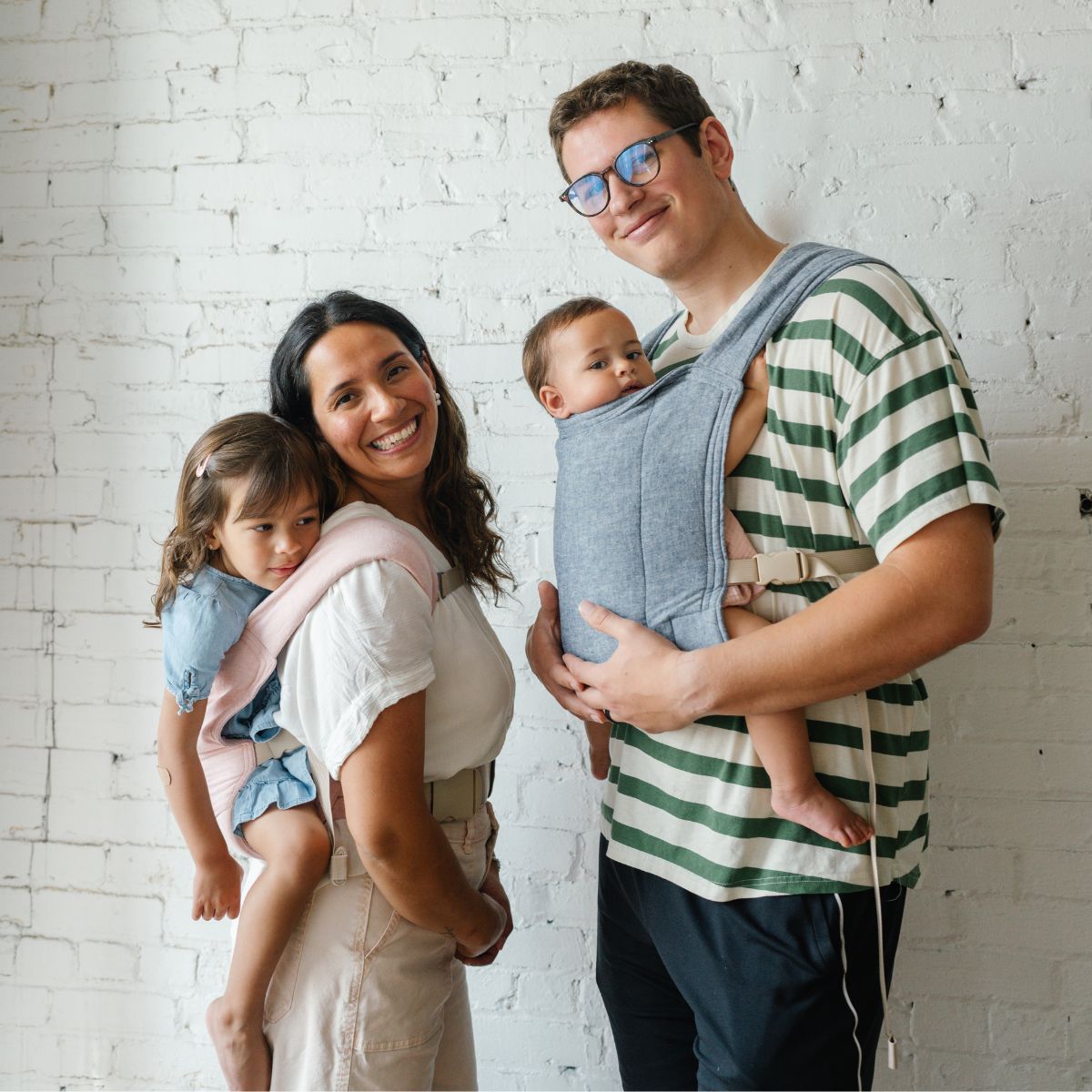
As you may have already heard from your healthcare provider, you are safe to keep doing most pre-pregnancy activities. This includes babywearing! If your body is used to carrying your older child, you can keep right on doing that, even as those nine months go by and your older kiddo keeps growing. You are not only conditioning your body to keep carrying your big kid, but you’re also getting ready to tandem wear! You are so strong!
That being said, it’s important to listen to your body. If something feels off, don’t push yourself. Try again the next day or seek advice from your provider. Also, it’s okay to take a break from carrying your bigger kid. But don’t expect to be able to jump right back into wearing if you take a break for a few months. You’ll have to work back up to wearing a bigger kid with a bigger bump. You will get there, but, again, always listen to your body.
What do I do with the waistband?
Many people find a comfortable way to wear Larks and meh dais – two carriers with waistbands – throughout their pregnancies. If you’re used to wearing on your natural waist, you’re fine to keep doing that as long as it feels good. Once it doesn’t, you’ll want to either move your waistband up above or down below your bump. And if that still doesn’t work, you can try a ring sling, a fully functional and supportive carrier without a waistband.

Help! My favorite carrier isn’t comfortable anymore!
Our bodies change throughout our pregnancy. Aside from the growing bump, you may have swollen ankles, a more irritated sciatic nerve, and more flexible joints. This may mean that your go-to carrier may not work for you anymore.
First things first, go back to the basics and make sure you have the best fit possible. Most likely, you’ve become a pro at putting on your favorite carrier, and you can do it with impressive speed. But slow it down the next time you put it on and check in with yourself each step of the way. Are you getting all the slack out? Is your wearee positioned correctly? Are all the straps spread and straight? With your growing bump and growing big kid, you may have to get a “closer to perfect” carry than you’ve been getting for it to be comfortable.

If you can’t figure it out on your own, post a fit check in our Facebook group or schedule a free one-on-one consult with one of our babywearing educators. Crowd sourcing for tips or doing a personal fit check can help you hone in on the one detail you were missing to get you the comfiest carry possible.
Finally, you may have to use a different carrier until things feel right again. If your go-to is a ring sling, but your shoulder is hurting, trying a two-shoulder carrier like a Lark or meh dai could be the answer. On the other hand, if you can’t get a comfy fit with the waistband either above or below your bump, it might be time to try a ring sling. Luckily, hope&plum has a wide variety of carriers to try. Many of them can be used now with your bump and older kiddo and then you can turn around and use them for your new baby when the time comes.
Wearing Tips for Each Carrier

Ring Sling
If your wearee has strong enough head and neck control, it’s best to wear in a hip carry. Remember, when you hip carry in a ring sling, you’re really centering baby between your hip and belly button.
Be mindful of your wearee’s bottom. It will probably be most comfortable if they’re not positioned on your bump. This may mean they’ll be a little higher than typical.
Optimize weight distribution. Make sure the sling is spread out as much as possible over your back and is capping your shoulder.
Lark
- Find the most comfortable placement for the waistband – either above or below your bump.
-
In a front carry…
Pull the shoulder straps down and across both to buckle them and to tighten.
Spread the fabric fully across your back.
-
In a back carry…
Stand up straight, reach towards the top of the panel, and bounce your wearee into position while tightening.
Fold the straps in half to give your shoulders more padding.
Meh Dai
Find the most comfortable placement for the waistband – either above or below your bump.
-
In a front carry…
Pull the shoulder straps first down and then across.
Optimize weight distribution. Spread the fabric fully across your wearee’s bottom and your back.
-
In a back carry…
Stand up straight, do a Y-pull, and bounce your wearee into position while tightening.
Optimize weight distribution. Spread the fabric fully across your wearee’s bottom and do a fancy finish to disperse the weight over your chest.
If you have the length in the shoulder straps, after setting up the carry, you can spread them over your bump and tie underneath for optimal support.
Baby Wrap
Set the carrier up above your bump.
Start with the carrier tied as as tightly as you can while still being comfortable.
Optimize weight distribution. Spread the fabric fully across your back.
“Babywearing” Your Bump
If this is your first kid or your older kiddo is too independent for carriers, you can still use a ring sling or baby wrap to support your bump. Set up your ring sling with your bump in the pocket and tighten until snug and comfortable. For your baby wrap, you can set it up like you would for a baby with the two shoulder straps. You could also start like that, but then bring the two passes that would typically come over your shoulders under your arm and over your bump instead, giving you three supportive passes over your bump.

Babywearing While Pregnant FAQ
Can you babywear while pregnant?
Yes! Most people with healthy pregnancies can safely babywear while pregnant. If your body is used to carrying your older child, you can usually continue—just listen to your body and follow your healthcare provider’s guidance.
Is babywearing safe during pregnancy?
Babywearing during pregnancy is generally safe if you’re comfortable and not experiencing complications. If you feel pain, pressure, dizziness, or unusual symptoms, stop and check in with your provider.
Where should I place the carrier waistband when pregnant?
You can wear the waistband at your natural waist as long as it feels good. As your bump grows, many people find it more comfortable to move the waistband above or below the bump. If neither feels right, try a ring sling or wrap without a waistband.
What is the best baby carrier to use while pregnant?
The best baby carrier during pregnancy is one that feels supportive and balanced. Many people still love their favorite carriers, just listen to your body and adjust and adapt as it changes.
Can I do a back carry while pregnant?
Yes, many parents continue back carrying while pregnant if it feels comfortable. Proper tightening, even weight distribution, and mindful posture are especially important as your center of gravity shifts.
Why does my favorite carrier suddenly feel uncomfortable?
Pregnancy changes your body—your bump grows, joints loosen, and posture shifts. Try slowing down your setup, removing hidden slack, and optimizing strap placement. Sometimes small fit adjustments make a big difference.
Can I use a baby carrier to support my bump?
Yes! You can use a ring sling or baby wrap to support your belly. Many people find this helps relieve pressure and adds gentle support during pregnancy.
Should I stop babywearing if I feel discomfort?
If something feels off, take a break and reassess. Babywearing while pregnant shouldn’t cause sharp or persistent pain. Adjust your fit, try a different carrier style, or consult your provider if needed.
Most people can babywear comfortably and safely throughout their pregnancy. It’s always important to listen to your body and the advice of your healthcare provider. Get a fit check for tips to keep using your favorite carrier or try a ring sling or baby wrap as bump support!

Leave a comment
This site is protected by hCaptcha and the hCaptcha Privacy Policy and Terms of Service apply.