


How Do I Babywear Safely and Comfortably? hope&plum’s Tips and Tricks
At hope&plum, every carrier we create is packed with love, comfort, and one of our most important values— safety. Safe babywearing is all about positioning baby and using your carrier correctly. Safety is key to keeping you and your little one snuggled up happily and comfortably. We’ve put together some easy-to-follow tips to help you feel confident every step (or nap!) of the way while wearing your baby. 💛
TL;DR:
Choose the right carrier for your baby's development.
Follow all carrier instructions and check out brand tutorials.
Inspect your carriers frequently, adding a quick check in each time you wear.
Get the right fit, practice, and listen to your body.

Choosing the Right Carrier
Starting your safe babywearing journey? It’s smart to do a little research first! Baby carriers come in different styles, each designed with specific features to fit certain weights, ages, and developmental stages. Finding the right one can make all the difference.
For example, baby wraps and the Sprout Newborn Carrier are perfect for those cozy newborn snuggles, but they’re not ideal for toddlers. Meanwhile, our Lark Baby Carrier is our go-to for older babies and toddlers—but it’s not a safe fit for a newborn.
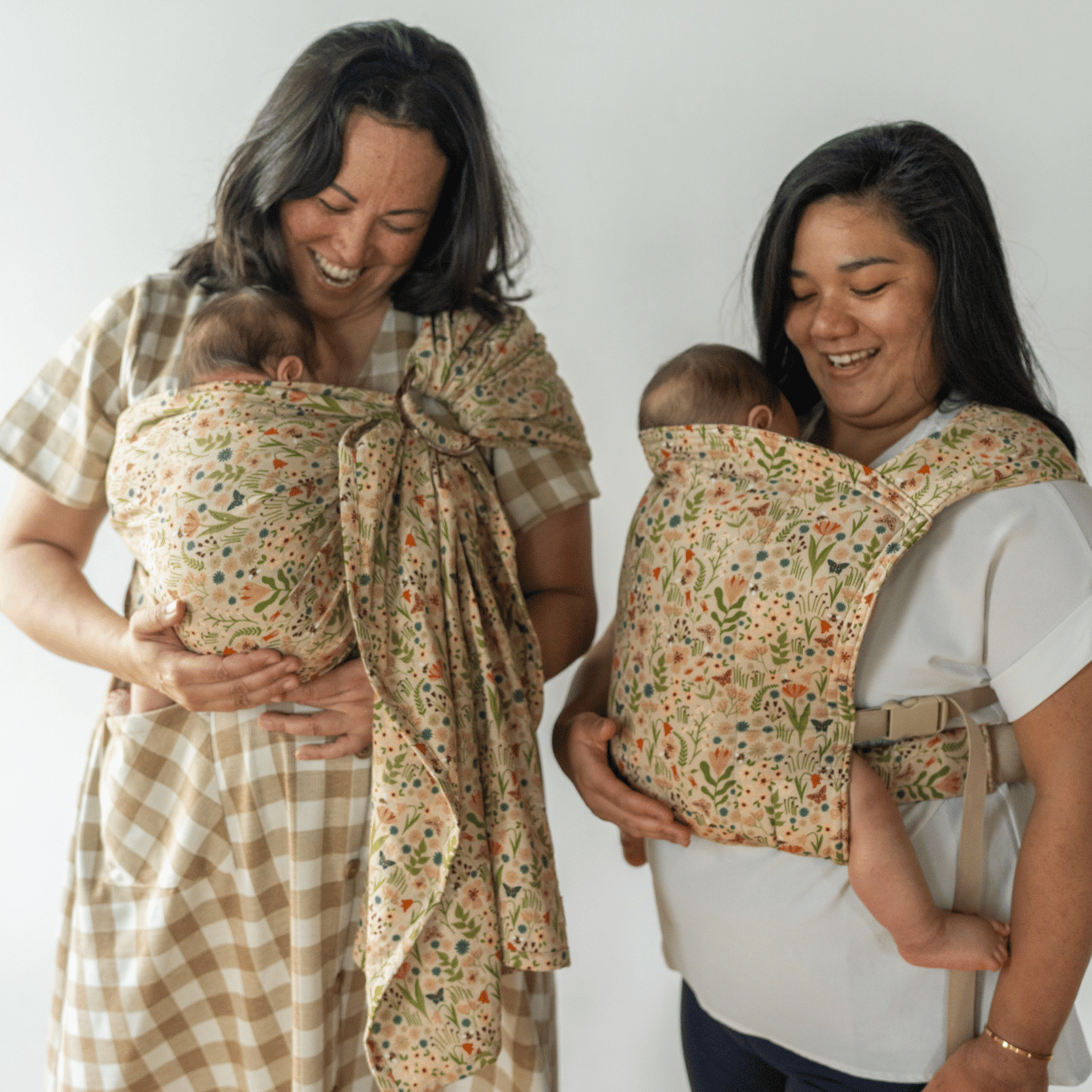
If you’re dreaming of versatile options, a Meh Dai or Lark will give you both front and back carry positions. Want to rock a hip carry? The ring sling is your best friend! Whatever your needs, there’s a carrier ready to support you and your little one through every adventure. ✨

Remember that not all of these babywearing positions are appropriate for all children. See below for a chart that shows the different positions, carriers that can be used for them, and the milestones your child should be achieving before trying them.
Position |
Carrier |
Milestone |
Front (facing inward), legs in |
|
|
Front (facing inward), legs out |
|
|
Hip |
|
|
Back |
|

Follow Manufacturer Instructions
After you purchase your carrier, be sure to read all included manufacturer instructions so you can practice safe babywearing. All hope&plum carriers come with instructional booklets that explain how to properly and safely use each carrier. We also have a tutorials page and free one-on-one consultations with our dedicated educator team.
You should also read all warning labels and tags on your carrier and familiarize yourself with the carrier’s weight limits.

Inspect Your Carriers
hope&plum carriers are made with care and integrity and are subject to the highest degree of babywearing safety testing. This is why they can truly become the stars of your parenting toolkit. You may reach for them all day every day, so they go through a lot. This is why it’s important to inspect your carriers to make sure they stay safe and secure for you and your little one throughout years of safe babywearing use.

Each time you go to grab your carrier to babywear your little one, do a quick safety inspection by answering “Yes” or “No” to the following questions:
- Do any weight bearing seams or hems show signs of unraveling or ripping?
Are any buckles cracked?
Is the safety loop on my Lark missing or not working properly?
(If doing a back carry in the Lark:) Is my chest strap missing?
If you answer “Yes” to any of these questions, it’s time to pause and reassess. Please stop using that carrier or position right away. You can order replacement parts on our website, or reach out to our customer support team at hello@hopeandplum.co with details about the issue—we’re happy to help!
In the meantime, use another carrier or switch up your carry position to stay safe while waiting. Our warranty covers manufacturing defects, but we can often help with things like broken buckles and more. It never hurts to ask! 💌

Proper Positioning for Safe Babywearing
There’s a ton of safe babywearing positioning advice out there, but we’re here to break it down into the basics! Whether you’re carrying a baby, toddler, or older child, these tips apply to all of our carriers:
- Your little one should always be upright. In a front or hip carry, their head should be close enough to kiss. 😘
- Their thighs should be fully supported to the knees, with their knees slightly higher than their bottom (think a comfy “M” shape for those legs!).
For infants, their head should rest gently on your chest with a natural curve to their spine that looks like a “C” from the side. As your child grows and gains head, neck, and trunk control, their posture will shift to a “J” shape with their torso and upper legs.

When worn properly, all of our carriers support your child’s natural development while keeping them snug, secure, and comfortable. Check out the graphics below for some visual tips on nailing those positions!
TIP: To see these larger, right click the image and view in another tab!


Letter |
Safety Rule |
What It Means |
How to Check |
T |
Tight |
Carrier should be snug against your body |
No sagging, baby doesn't slump |
I |
In view |
You can see baby's face at all times |
Fabric doesn't cover face, chin visible |
C |
Close enough to kiss |
Baby's head is kiss-distance from your chin |
Bend head forward to kiss without straining |
K |
Keep chin off chest |
Airway is open |
At least 2 finger widths between chin and chest |
S |
Supported back |
Baby's back is firmly supported |
No slouching, natural C-curve for newborns or J-curve for older children |
Practice Makes Perfect
Now it’s time to practice safe babywearing with your carrier! If baby isn’t here yet, or even if they are, it can be a good idea to practice with a stuffed animal, doll, or even pillow. This way you can get the basics down without the risk of dropping your baby or using the carrier incorrectly. When you’re ready to try with baby, don’t get discouraged if you don’t get it right immediately.

All carriers have a learning curve, and it can take some time to get used to safe babywearing with something new! hope&plum has lots of instructional videos and wearing tips on our website, Facebook group, Instagram, and TikTok. And we offer free virtual fit checks for anyone with one of our carriers whether purchased from our store or from another community member.

Listen to Your Body
As you get more comfortable babywearing and using your carrier with your child, make sure you’re listening to yourself and your body. If something feels off or not right, stop, reposition your child, or them off and start again. If you’re experiencing discomfort or pain, stop, reposition your child, or them off and start again.

Safe babywearing isn’t just about the carrier—it’s also about building up your own strength! Don’t worry if you can’t carry your toddler for hours right away. It’s totally normal for your body to need time to adjust. Think of it as working toward a goal, one snuggle at a time. 💪
But listen to your body—pushing too hard or wearing the carrier incorrectly can lead to discomfort or even injury. At hope&plum, we’ve designed carriers to be as comfortable as possible for everyone. If you’ve eased into it, followed all the safety tips, and still feel uncomfortable, it might be time for a fit check. Or honestly? Just get a fit check anyway—we’re always here to help! ✨

Listen to Baby Too!
And don’t forget to listen to your baby! Typically developing babies will let you know when they’re uncomfortable. If your baby cries for more than five minutes in the carrier and nothing soothes them except taking them out, there’s a good chance something needs adjusting.
But let’s be real—just because a baby is worn correctly and comfortably doesn’t mean they’ll never fuss. Babies fuss all the time (even if they love being worn!). They might be hungry, need a diaper change, or just be frustrated that it’s taking you longer than 0.2 seconds to set up your carrier. 😅
A little wiggling or stretching is totally normal too. Babies are just doing what they do best—letting us know how they feel! 💛

If your baby is fussy in the carrier, take a moment to check that you’re following all the safety tips. Then try switching things up—bounce a little, walk around, head to a different room, or step outside for a change of scenery. 🌞
Still fussy? No problem. Take a babywearing break! Take them out and check if they’re hungry, need a diaper change, or just need a little reset. And if nothing else works (you know where I’m going with this 😉)— schedule a fit check! We’ll help you and your baby get comfy, happy, and ready for more snuggles. 💛

Safe Babywearing FAQ
What's the most dangerous mistake in babywearing?
Allowing baby's chin to rest on their chest, which can restrict airway and cause positional asphyxiation. This is especially dangerous for newborns under 4 months. Always ensure you can see baby's face, chin is lifted, and airway is clear.
How do I know if my baby is breathing okay in the carrier?
You should observe baby's chest rising and falling and feel their breath on your body. Baby's skin color should be normal, not pale or blue and baby should be responsive, not limp. A proper fit will allow you to monitor this in the background constantly, but it's a good idea to deliberately check in every 10-15 minutes for a newborn or a sleeping baby at any age.
Is it safe to breastfeed in a baby carrier?
Yes, with a few things in mind! Nurse in an upright position. Loosen the carrier just enough to get baby access. Keep in mind that this lowered nursing position may not longer be handsfree. Always reposition baby back to that T.I.C.K.S. position after feeding. Never keep baby in a loose and lowered carrier, even if they're asleep. After nursing, return baby to a snug position with head supported and airway clear.
What activities should I never do while baby wearing?
Never: cook over hot stoves, ride bikes/motorcycles, drive cars, use power tools, ride horses, jump/run vigorously, or sleep with baby in carrier.
Use extreme caution: hiking on uneven terrain, bending repeatedly, or during sports.
How tight is too tight in a carrier?
The carrier should be snug but not restrict breathing. You should be able to slide a flat hand between baby and the carrier fabric. Baby's body shouldn't be compressed, but should be firm against you with no sagging. If baby's skin changes colors, loosen or take baby out and readjust. Keep in mind, some compression marks are totally normal as long as they don't hurt baby and fade away after a little while post-wearing.


Leave a comment
This site is protected by hCaptcha and the hCaptcha Privacy Policy and Terms of Service apply.