


A Complete Ring Sling Safety Guide: How hope&plum Takes You from Newborn to Toddler

Ring slings are hope&plum’s original carrier. We love that you can use them not only in those fresh newborn days but also throughout the toddler years. As with everything babywearing, ring sling safety is the top priority. It’s best to start with some general babywearing safety guidelines. Then, you can expand that knowledge to specific ring sling safety tips. Finally, you can become an expert in using your ring sling to grow with your baby.
The Short Version
- Ring slings work from newborn all the way through toddlerhood — but the fit looks a little different at each stage.
- The golden rule: baby upright, knees higher than bottom, and head close enough to kiss.
- For newborns, front carry only — pull the fabric up to the nape of their neck for full head support.
- Once baby can sit on your hip with one hand (or is rolling!), they're ready for a hip carry with arms out.
- Threading correctly is non-negotiable — always leave at least 10 inches of tail through the rings and keep the top and middle of the sling snug.
- Start smaller than you think: a pocket that looks too small is always easier to fix than one that's too loose.
General Babywearing Safety
There’s a ton of safe babywearing positioning advice out there, but we’re here to break it down into the basics! Whether you’re carrying a newborn, baby, or toddler, these tips apply in any carrier:
Your little one should always be upright. In a front or hip carry, their head should be close enough to kiss.
Their legs should be in a spread-squat position, with their knees slightly higher than their bottom.
For infants, their head should rest gently on your chest with a natural curve to their spine that looks like a “C” from the side. As your child grows and gains head, neck, and trunk control, their posture will shift to a “J” shape made with their torso and upper legs.

One of our favorite babywearing safety tips is T.I.C.K.S. This is an easy-to-remember acronym to help keep your baby safe in any carrier.
Babywearing Safety Check
T.I.C.K.S. Rules for Safe Babywearing
Tap a letter to learn what it means and why it matters for your baby.
↑ Tap any letter above to see the safety rule

T: Tight
Your ring sling should be snug enough to hug baby close to your body. A loose carrier lets baby slump down, which can block their airway.
Why it matters: A snug fit keeps baby's chin off their chest and their airway open. If you can fit a flat hand between you and baby, it's too loose.

I: In View at All Times
You should always be able to see baby's face by glancing down. Fabric should never cover their nose or mouth.
Why it matters: Pull the top hem to the nape of a newborn's neck, never over their head. You need a clear view to spot any positioning issue right away.

C: Close Enough to Kiss
Baby's head should be high enough on your chest that you can tip your chin down and kiss the top of their head.
Why it matters: If baby is too low, their chin can drop to their chest and restrict their airway. Higher is always safer.

K: Keep Chin Off the Chest
There should always be at least two fingers' width of space between baby's chin and their chest.
Why it matters: A chin-to-chest position can compress the airway. Check this every few minutes, especially when baby falls asleep.

S: Supported Back
Baby's back should be supported in its natural position, with their tummy and chest against you. Knees should sit higher than their bottom in a spread-squat (M-shape) position.
Why it matters: Proper back support keeps baby's spine in a healthy C-curve (or J-curve for older babies) and protects their developing hips.
Not sure if your fit passes the T.I.C.K.S. check? Get a free virtual fit check with our team, and we'll make sure baby is safe and comfy.
Book a Free Fit CheckGeneral Ring Sling Safety
In addition to the general babywearing safety tips from the previous section, it’s helpful to know a few more specific ring sling safety tips:
Thread correctly so that the fabric stays in place.
You should always have at least 10 inches of tail through the rings along the short edge.
A snug fit in the top hem and middle of the sling will keep baby safely in the sling even if they pop their seat (straight their legs, move their bottom out of the hammock, and “pop” the bottom hem up towards their back).
We don’t recommend doing a back carry in a ring sling.
Let’s take a look at each safety tip:
Ring Sling Setup Safety
4 Non-Negotiables for a Safe Carry
Master these and you've got the safety basics down, every single time.
Thread it like a belt
Tail goes up through both rings, then back over one ring and under the other. No twists in the fabric, ever. Correct threading is what holds the whole carry together.
Leave 10+ inches of tail
After loading baby and tightening, you should still have at least 10 inches of fabric hanging through the rings. That's your safety buffer if any fabric shifts.
Snug at the top and middle
A tight top hem and middle pocket hold baby in place even if they "pop their seat." It buys you the seconds you need to fix their position before anything goes sideways.
Skip back carries in a ring sling
Technically possible, but hard to troubleshoot if baby shifts. For back carries, reach for a Lark or meh dai instead. They're built for it.
"It easily moves through the rings but is still thick enough that it feels secure."
Janelle F. · Barley Ring Sling ★★★★★
Want to see threading and setup in action? Watch our step-by-step tutorials, or shop a ring sling that comes with our virtual fit-check.
Watch Tutorials Shop Ring Slings
Ring Sling Safety By Age
Newborn
Newborns should be worn in a front carry. They lack the strength to hold up their heads in a hip carry. For this reason, the safest place for your tiny baby is centered right against your chest. Their head should rest on your chest so they’re close enough to kiss, and their head, back, and tucked legs should make a C-shape against your body.
You can wear your newborn with legs in or out. We recommend trying legs out first. It's safe from birth. Plus, most babies do just fine in this position. If your newborn is so curled up they seem uncomfortable in this position - they don’t uncurl, they cry unless you take them out of the sling - you can try legs in. Make a small pocket and fold it in half so the “bottom” is in the middle of the sling. Slide baby in, making sure their weight is on their bottom, not their legs, and their legs are tucked up in a froggy position. Baby’s weight should never rest on their feet.
You should pull the top hem up to the nape of your newborn’s neck and snug up the top hem to offer the proper amount of support for their head and neck.
Newborng Ring Sling FAQ
Are ring slings safe for newborns?
Yes! Ring slings are one of our favorite safe and hands-free newborn carriers. Ring slings support a newborn's head, neck, and trunk in their spine in the proper C-shape and the hips and knees in the proper M-shape. Ring slings are super snuggly, fast to get on and take off, and allow for easy feeding support. All great features for that fourth trimester!
What is the weight requirement for a newborn ring sling?
All our ring slings are safety tested for infants and toddlers weighing 7 to 35 pounds. If you want to use your ring sling before your baby is 7 pounds, seek advice from your healthcare provider!
How do you position your newborn?
When using a ring sling with a newborn, you can use two carries: tummy to tummy with legs in (commonly known as a "newborn carry") and tummy to tummy with legs out (known as a "front carry" and is suitable for newborns as well). There isn’t a "best carry" with a newborn in a ring sling, as it’s dependent on you and your babe!
Some babies love to be carried in the ring sling with their legs in, and some prefer their legs out immediately. We recommend trying with legs out first. You'll eventually need to switch to this anyway. If baby seems uncomfortable or won't uncurl, try legs in. Whichever feels better for you and your newborn is fine!
Check out our step-by-step visual guide for more details!
Which fabric is best for a newborn?
The best ring sling will be the one you're most comfortable using! All of our fabrics are pre-washed and soft enough for your newborn. If you’re new to using a ring sling, you may prefer to use a ring sling made with a single layer of fabric like our linen/cotton blend, as it will be easier to learn with.
Is there a time limit for using a ring sling with a newborn?
There’s no time limit! You can wear your newborn in a ring sling as long as you and your baby are comfortable and happy.
Can plus-size parents wear their newborn in a ring sling?
Absolutely! We've heard from some plus-size parents that they are concerned about using a ring sling with a newborn, but we promise you won’t hurt your baby! Your little one will let you know if they feel uncomfortable. If you are concerned that their legs are too stretched, you can center them over the breast farthest from the rings rather than centered on your chest.
How do you keep your baby's feet from turning in?
It’s OK if their feet turn! Look at your baby’s natural positioning when you hold them on your chest: this is the position you want them to assume when they are in the ring sling, with their legs in. If you’re doing the legs out carry, it’s absolutely fine for their legs to turn in a bit, instead of out, like you see with older babies.
How do you maintain an ergonomic position in the ring sling?
Some newborns prefer to tuck their feet under their hips, while others may choose the “froggy position,” where their legs fall to either side of their body. Both of these positions are suitable and safe.
The main safety checks when using a newborn carry are:
- ensure your baby is not sitting on their feet
- keep them close enough to kiss
- check that their airway is clear
- make sure their back is well supported and they're not slouching to either side
Do you have any other carriers recommended for newborns?
Ring slings are our first love, but we know not every carrier works for every family. If you're looking for other snuggly, safe, and supportive newborn carriers, we suggest our baby wrap, Sprout Newborn Carrier, or meh dai. Want to learn more? Read our separate post for all of our top newborn baby carrier picks

Infant
Pay attention to your infant’s behaviors in the ring sling and developmental milestones. These will help you make some changes to how you’re wearing your ring sling. If you’ve been wearing your newborn with legs in, switch to legs out once they start pushing to stand. If they’re hitting this milestone and their legs are in, they can stand up in the carrier, creating a fall hazard.
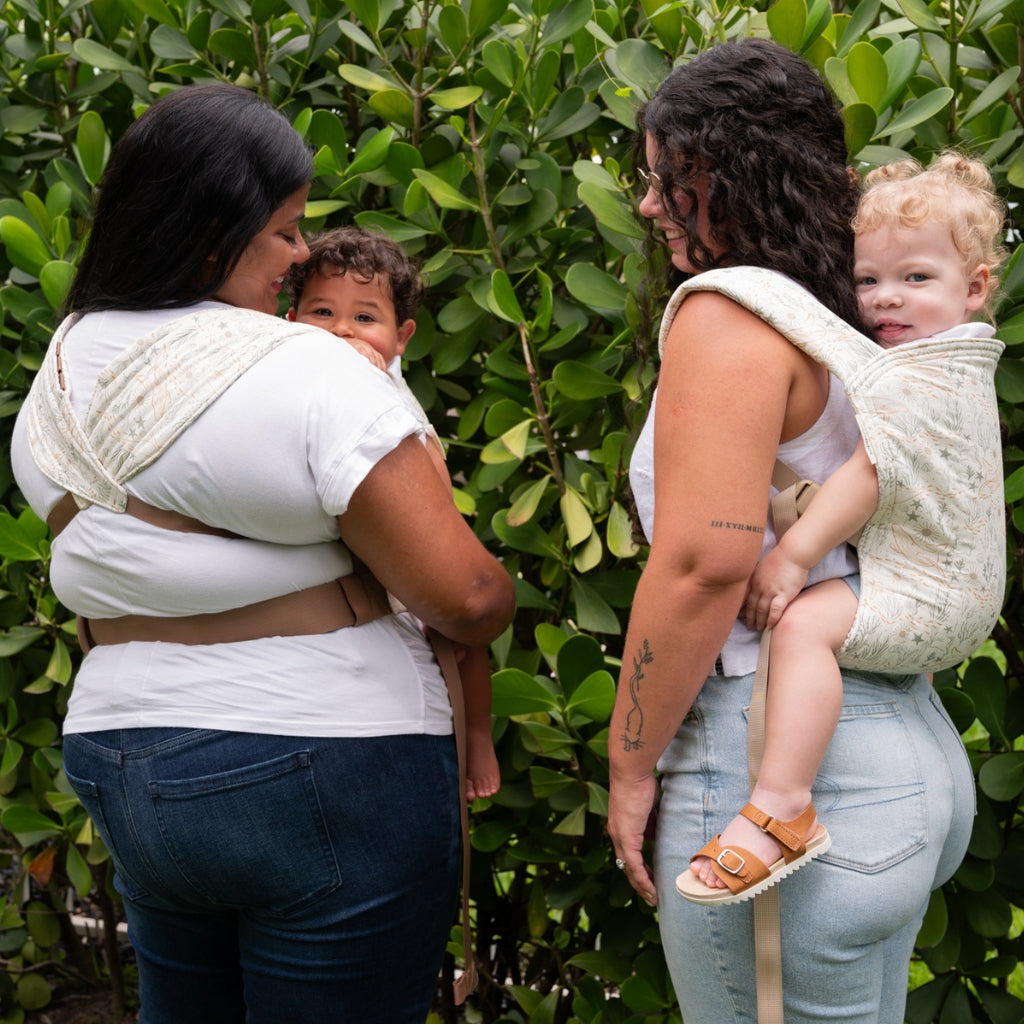
Ready for a hip carry? Watch for two milestones: can you hold baby on your hip with one hand (no carrier)? Or are they rolling either direction? Either one is your green light — you don't need both. Growing babies like this position because they can see around more, but they can tuck into you and self-regulate if they feel overstimulated. For babies who are hitting this milestone, you can also pull the top hem to their armpits and let them have their arms out. This gives them even more freedom! And you can always tuck those arms in for more support if they fall asleep.
If they’re not there yet, that’s okay! It’ll come! Keep them in a front carry. But you might be seeing more of a J-shape when they’re awake and alert and only that C-shape when they’re asleep. You may have to make your pocket bigger so they’re not as high as they grow. Always make sure you’re sizing your pocket to look a little too small before putting your baby in.

Older Baby
Older babies should definitely be worn legs out and typically have enough strength for a hip carry with their arms out. You can still opt for a front carry, but many people find hip carries easier and more comfortable as their babies grow. As always, start with a pocket that looks a little too small for your baby. As your baby grows, focus on comfort: keep your rings in a good spot, spread your shoulder fabric, and get the fabric as wide as possible across your back. Small adjustments make a big difference!

Toddler
For toddler-wearing in a ring sling, make doubly sure you set up your sling properly. Small changes from optimal ring placement and fabric spread will make a big difference in your comfort as you enter toddlerhood. Also, make sure you’re still getting your toddler a nice, deep seat, spreading the fabric from knee pit to knee pit (the back of the knee). This will ensure they are comfortable too! It can be hard to load your toddler from the top, especially with a pocket that’s small enough. Instead, you can try bringing the fabric up over their back, loading them from the bottom. Still sit them on the tube to get them positioned properly and tighten the whole sling so they come up to the right height if they seem too low in a big pocket.

Ring Sling Safety and Tips by Age
Ring Sling Guide
Safety & Tips by Age
Top Ring Sling Tips
Now that you know all about ring sling safety from newborn through toddlerhood, let’s look at the top ring sling tips for getting a comfy fit for both you and your baby:
Start with a pocket that’s smaller than you think you need. For real. Make a small pocket. Check it. If you think it’s big enough for your baby to fit, it’s too big! You should look down at your pocket and think, “This looks just too small.” It’s easier to loosen the pocket if it’s too tight than to tighten it if it’s too loose!
Load baby on the tube of fabric and keep it bunched in their knee pits. Your goal is to get baby’s bottom settled over the top of the tube with knees tucked above bum. Their body should be positioned like it will when you’re done setting up the carrier, except the fabric is all bunched at their knees and not spread over their back yet. After baby is positioned properly, bring the top hem up.
When making a seat, only bring up enough fabric to make a straight line from knee to knee. Your goal is to make a straight line with the fabric, not a triangle. Pulling up a bunch of extra fabric between you and baby doesn’t make a deep seat. Using the fabric to hammock baby’s knees above their bottom is what gives you a secure, deep seat.
Push up on baby’s bottom when tightening. Think of it like a lock and key: your baby's weight locks the rings in place. To tighten, push up on baby's bottom to take the weight off, then pull the tail through little by little.
Pro Tips for a Safe, Comfy Carry
4 Tips for Nailing Your Ring Sling Fit
Tap through each tip to see what it looks like and why it keeps baby safe.
↑ Tap any step above to see the tip in action
Start with a pocket that's too small
If you look down and think "this looks just about right," it's already too big. Start tight. It's way easier to loosen a pocket than tighten one with baby already in it.
Why it matters for safety: A too-loose pocket lets baby slump down, which can compromise their airway and break the T.I.C.K.S. rules.
Load baby on the tube of fabric
Settle baby's bottom over the tube with the fabric bunched in their knee pits. Get their position right before you bring the top hem up and spread the fabric.
Why it matters for safety: Positioning baby first means their weight is supported by the seat, not by their feet, which protects their developing hips.

Make a straight line, not a triangle
A deep seat comes from spreading fabric from knee pit to knee pit, not from pulling up extra fabric between you and baby. Straight line = secure seat.
Why it matters for safety: A proper knee-to-knee spread gives baby the M-shape position pediatricians recommend, and prevents popped seats.
Push up on baby's bottom to tighten
Think of the rings like a lock: baby's weight locks them in place. Lift baby's bottom to take the pressure off, then pull the tail through, little by little.
Why it matters for safety: Proper tightening is what makes the carry snug and secure. A loose sling is the #1 cause of unsafe positioning.
"I also had a fit check with hope&plum team and I would highly recommend both the ring sling AND the fit check to everyone!"
Evian L. · Botanique Ring Sling ★★★★★
Want one of our experts to walk you through your fit live? Book a free virtual fit check, or grab a sling and we'll help you get it perfect.
Book a Fit Check Shop Ring Slings
Ring Sling Safety FAQ
Is a ring sling safe for newborns?
Yes! Ring slings are one of the best carriers for newborns when used correctly. Keep baby in a front carry with their head supported at the nape of the neck, their chin off their chest, and their body close enough to kiss. Always follow the T.I.C.K.S. guidelines for safe babywearing.
How do I know if my ring sling is threaded correctly?
Correct threading is the foundation of ring sling safety. The tail should come up through both rings, then back over one ring and under the other — just like a belt. Make sure there are no twists in the fabric and that you always have at least 10 inches of tail left after tightening.
How tight should a ring sling be?
Your ring sling should be snug enough that baby can't slump, but not so tight that it restricts their breathing. A good rule of thumb: baby should be close enough to kiss, with their knees slightly higher than their bottom. Always snug up the top hem and the middle of the sling for the most secure fit.
When can I wear my baby in a hip carry?
Your baby is ready for a hip carry when they can sit on your hip with just one hand (no carrier needed) OR when they're rolling in either direction — you only need one of these milestones, not both! Most babies hit this stage somewhere between 3 and 5 months.
Can you do a back carry in a ring sling?
We don't recommend it! While it's technically possible, back carries in a ring sling are hard to troubleshoot safely if baby shifts out of position. If you love back carrying, a Lark or meh dai carrier is a much better fit.
What is a "popped seat" and why does it matter?
A popped seat is when baby slides out of their proper seated position in the sling — knees drop, bottom sinks, and they're no longer in that secure spread-squat position. It happens to everyone! That's why keeping the top hem and middle of your sling snug is so important — even if baby pops their seat, a well-fitted sling gives you time to fix it before anything goes wrong.
How do I make a ring sling comfortable for a toddler?
Toddler wearing is totally doable in a ring sling — it just requires a little more precision. Make sure your rings are in a good position on your shoulder, spread the fabric as wide as possible across your back, and get a deep seat by spreading the fabric all the way from knee pit to knee pit. Small tweaks make a big difference when you're carrying more weight!
Ready when you are
Start Your Ring Sling Journey
From your tiniest newborn snuggles to quick lifts with your toddler, our ring slings are made to grow with you and your baby. Here's what's behind every sling we make.
We're here for every step, from your very first wear to your hundredth.
Meet the Author

Jenn Tolisano
Jenn Tolisano has been a babywearing educator for over ten years. Working as a high school teacher before entering the world of motherhood, she has brought her passion for education to all things baby carriers. Babywearing has been such an essential parenting tool in her household that she wants to spread the babywearing love to all families. Jenn believes that every caregiver deserves to have a baby carrier they love and feel comfortable and confident in. She hopes that her fit checks and blog-writing with hope&plum help to achieve that goal!

Leave a comment
This site is protected by hCaptcha and the hCaptcha Privacy Policy and Terms of Service apply.