


Ring Sling vs Soft Structured Carrier: Which is Best for Me and My Baby?

The best carrier for you and your baby is the carrier that works best for you right now. If you’re considering a ring sling vs soft structured carrier, the truth is that either could work for most families. It could be a ring sling if you have time to learn a new skill, easy carrier-nursing is at the top of your priority list, or you want a more traditional style carrier. It could be a soft structured carrier if you want to buckle on and go, you want to easily and safely back carry, or you have an older baby or toddler. Read on for more information on how to choose the best ergonomic baby carrier type for you.
THE SHORT VERSION
Ring slings offer quick ups and downs, one-shoulder carrying, and work well for nursing, but require practice to master.
SSCs provide structured support, even weight distribution, and work immediately, but are bulkier and more expensive.
Choose ring slings for home use and quick errands.
Reach for SSCs for hiking, long outings, and back carrying.
hope&plum offers a thoughtfully designed, ergonomic SSC for every age from newborn to toddler and beyond.
Table of Contents
What is a Ring Sling?
What is a Ring Sling and How Does It Work?
A ring sling is a length of fabric with two rings sewn into a loop at one end. To use a ring sling, slip it on like a sash with the rings sitting near one shoulder. Load baby’s legs through the tube of fabric. Center newborns and young infants on your chest in a “front carry.” You can wear older babies and toddlers off-center in a “hip carry.” Either way, create a seat for your baby by scooping the fabric around their bottom, spreading it from knee to knee to support knees above bottom in a spread-squat. Tighten the ring sling to keep baby in an upright, snug, and safe position. To get nerdy, the physics of the ring sling is that your baby’s weight locks the rings. This keeps them in place as long as you’ve threaded and tightened your sling correctly. Want to know more? Read our full ring sling visual instructional guide in our other blog post.
Those are the basics, but for such a stripped-down carrier, the fabric type and how it’s sewn can make a big difference. While some other brands use synthetic fibers or blends that never break in, hope&plum ring slings are made from natural, organic fibers and safety-tested aluminum rings. Our shoulder is designed to distribute weight evenly across your back, rather than sit narrowly or rely on bulky padding that won’t give everyone the custom fit they need.
What Different Fabrics Are Used for Ring Slings?
hope&plum ring slings are manufactured in the US with organic fabric. They come in either a hemp/cotton or linen/cotton blend. Both are breathable, comfortable, and supportive for most babies. Our linen/cotton is a single layer of fabric and may be better for smaller baby snuggles. Our hemp/cotton has a double-layer of fabric, so it feels more supportive if you’re mostly wearing a toddler who thinks they want to walk by themselves until they don’t. But both work just fine with all ages. Our lighter hemp/cotton colors and prints are the only carrier we recommend for wading in water, so it could be a good choice to keep cool on those summer days.

What is an SSC?
Soft structured carriers or SSCs are carriers that have a waistband, a panel connected to the waistband where the baby sits, and shoulder straps connected to the panel. Typically, the waistband is connected with a buckle, and the shoulder straps may be sewn into the panel or could also have buckle attachments. Unlike hard framed carriers or hiking carriers, the panel on most SSCs has some structure, but doesn’t stand on its own.

Waterfall Waistbands
- Buckle at either the natural waist or on the hips
- Lots of padding
- Panel folds over the top of the waistband
- Highly supportive in the waistband, but can be less comfortable
- Can feel bulky and hot
- Hard to fold compactly
- Less friendly for C-section recovery

Apron Waistbands
- Buckle either right under the chest or at the natural waist
- Some or no padding
- Panel hangs straight down from waistband
- Less support in the waistband, but built-in support elsewhere
- Feel lighter and cooler
- Fold down compactly
- More C-section or pelvic floor friendly
CourtneyF, Lark Baby Carrier“I thought I hated any carrier that goes around my waist, but this fits so well, it takes weight off your shoulders making long carries comfy.”

H-Back Straps
- Attach to the panel around the shoulder
- Connected by a horizontal strap
- After adjusting correctly once, readjust if baby grows or sharing the carrier
- Sharing and buckling the horizontal strap can be hard

X-Back Straps
- Attach to the side of the panel
- Cross over back for front carry
- Custom set up each time = more time, but easier sharing
- Easily shared + independent set up = custom and cozy fit
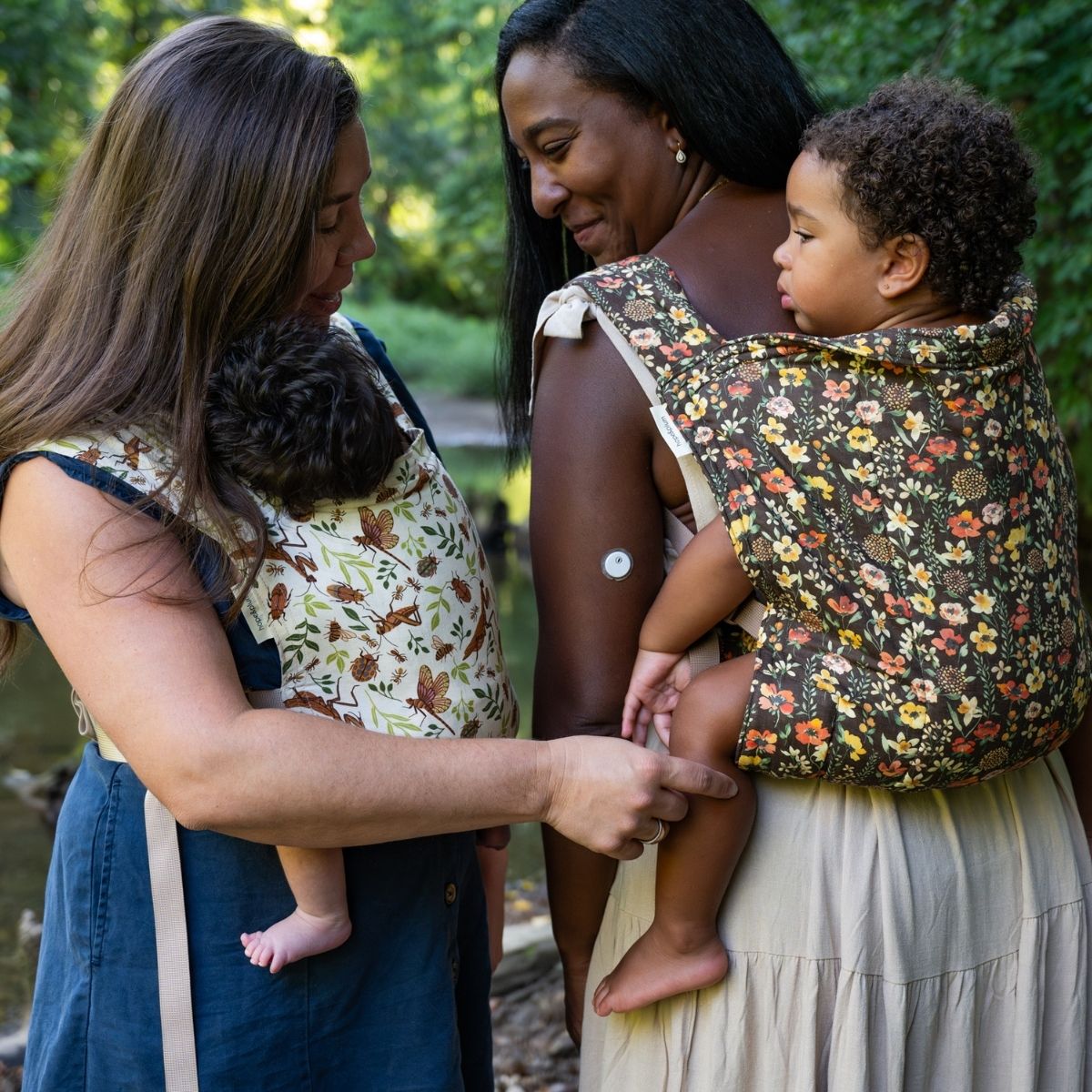
Note: The Lark converts to H-back straps for a back carry, allowing for optimal comfort and weight distribution.
Elizabeth W, Lark Baby Carrier“I previously used an H-strap carrier and the straps on the Lark distribute the weight much more evenly!”
SAFETY WARNING: Because of the structure their name implies, many SSCs work great for heavier kids like older babies and toddlers. Depending on design, they may be unsafe for newborns.
- Read weight minimums and maximums carefully
- Familiarize yourself with a brand’s safety guidance and age recommendations
RED FLAG: A brand that lacks safety guidance or posts content that goes against it

Pros & Cons: Ring Sling vs Soft Structured Carrier
Let's see how these two popular carriers stack up when we put their pros and cons side by side.
Ring Sling
Pros
- Quick up and down
- Excellent for nursing
- Compact & Portable
- One size fits most
Cons
- One-shoulder strain
- Has a learning curve
- Less back support
- Not ideal for hiking or exercise
SSC
Pros
- Even weight distribution
- Small learning curve
- Better for long carries
- Great for back carrries
Cons
- More expensive
- Can be bulkier to store
- Sizing can be tricky, especially to share
- Less nursing-friendly

How Are hope&plum SSCs Different?
At hope&plum, we pride ourselves on designing thoughtful and intuitive SSCs. We keep baby's safety and ergonomic positioning plus your comfort in mind with every style of carrier, our buckle carriers included.

Should I Choose a hope&plum SSC or Ring sling?
Whether you choose a hope&plum SSC or ring sling depends on your specific needs and that of your family. Now that you know about all the great features hope&plum offers in both ring slings and buckle carriers, which is right for you?

Comprehensive Comparison Table
Let's compare all the important features across ring slings, typical waterfall-style SSCs, and hope&plum's thoughtfully designed suite of buckle carriers.
| Feature | Ring Slings | Most Waterfall Style SSCs | hope&plum SSCs |
|---|---|---|---|
| Learning Curve | 2-3 weeks to master | Use immediately; may need additional help for the best fit | Use immediately; may need additional help for the best fit |
| Setup Time | A few minutes, less after mastery | 30 seconds without personal adjustments; can take longer if sharing | 30-60 seconds |
| Weight Distribution | One shoulder + evenly over back | Both shoulders + hips | Both shoulders + evenly over back + waist |
| Best Ages | Newborn-3 years | 3 months-3 years | 3 carriers that take you from newborn to preschool-age and beyond |
| Positions | Front, hip | Front, back | Sprouts - front only; Larks - front, back |
| Packability | Highly compact | Can be bulky | Compact |
| Nursing Friendly | Excellent | Moderate | Great |
| Back Support | Medium | Excellent | Excellent |
| Partner Sharing | Easily shared; hope&plum offers 3 inclusive lengths | May need adjusting; some brands have limited sizing | Easily shared if overlap in sizing; Short (XXS-L); Long (XL-6X) |

Ring Sling vs Soft Structured Carrier FAQ
Which is better for a newborn: ring sling or SSC?
Ring slings are typically better for newborns because they mold to baby's body and allow easy position adjustments. SSCs require special adjustments or a shorter panel, which leads to less longevity. The hope&plum Sprout Newborn Carrier is a great pick for families who want the ease of an SSC, but the safe, snuggly, ergonomic support of a ring sling for their newborns.
Can you breastfeed in both ring slings and SSCs?
Yes, but ring slings can be easier for feeding baby. The fabric can be loosened to lower baby to breast level without removing the carrier, but it is not as easy to nurse on the ring side. In SSCs, you typically need to loosen straps considerably, which some parents find cumbersome, but it is easier to nurse on either side.
Which is easier for beginners?
All baby carriers have a learning curve. SSCs can be easier for absolute beginners, though tweaks are needed to get a proper fit. Ring slings require practice to achieve a secure, comfortable carry. However, once mastered, many parents find ring slings faster for quick trips.
Which is better for back pain?
SSCs typically cause less back pain for extended use because they distribute weight across both shoulders and hips. Ring slings spread wait across the back and shoulder, but still concentrate weight on one shoulder only, which can cause strain during long carries or with user error.
Which is better for travel?
Ring slings win for packability because they fold into a small bundle. SSCs are bulkier but better for all-day sightseeing. Many traveling families bring both: ring sling for quick use, SSC for long days out. Keep in mind, ring slings have metal rings, so you will have to take them off to go through airport security. Note: hope&plum’s Sprout offers the best of both worlds for smaller babies. They are super packable, but also offer two-shoulder support and are free from metal.
How do I decide between them?
Consider your primary use case. Home/quick errands/nursing = ring sling. Hiking/long outings/back carrying = SSC. Active parents often own both for different situations.
Meet the Author

Jenn Tolisano
Jenn Tolisano is hope&plum's Director of Community Education & Content. She has been a babywearing educator for over ten years. Working as a high school teacher before entering the world of motherhood, she has brought her passion for education to all things baby carriers. Babywearing has been such an essential parenting tool in her household that she wants to spread the babywearing love to all families. Jenn believes that every caregiver deserves to have a baby carrier they love and feel comfortable and confident in. She hopes that her fit checks and blog-writing with hope&plum help to achieve that goal!

Leave a comment
This site is protected by hCaptcha and the hCaptcha Privacy Policy and Terms of Service apply.